When Should You Specify a Bubbled Pendant Over a Traditional Staircase Chandelier?
Introduction: The Moment You Walk the Stairs, Light Tells the Truth
You enter at dusk. The stairs rise high—cold, a little harsh on the eyes. Our chandelier supply company is on-site with samples and spec sheets. A designer whispers about glare, dust, and a schedule that is already tight. Early data says up to 28% of lighting rework in lobbies comes from poor beam control and driver mismatch (yes, that much). Would a bubbled glass pendant light solve the problem without the bulk of a classic crystal frame? Or do we stay with the icon, the big luminaire? We think about CRI, lumen output, and dimming curves—simple words, big effects. And we think about people who must feel safe on each step. So, when do we choose? When do we hold?
Let us compare, with calm. Short lines. Clear logic. Small details that change everything (and budgets). Then we move to what comes next.
The Deeper Layer: Hidden Pain Points You Don’t See in the Render
Where do the small issues hide?
Start with the stairs. Sightlines are tricky. Reflection from glossy treads can blind. Traditional chandeliers often flood light, not guide it, so shadows fall where you walk—funny how that works, right? A modular system like a bubbled glass pendant light lets you tune drop height and spacing to match risers and landings. That means more uniform vertical illumination and fewer dark zones. It also means easier maintenance: single points of access, lighter components, less scaffold time. Hidden enemy number two: flicker. Budget fixtures pair poor driver circuitry with long cable runs. Result? Unstable dimming, low power factor, and eye strain on slow fades. Stairs become a stage for that problem. Look, it’s simpler than you think: stable drivers, correct transformers, and a reasonable Kelvin range reduce risk fast.
There is also color truth. Many lobbies use wood, stone, and art. A low CRI washes them flat. With glazed bubbles, the optical diffuser softens peaks and lifts perceived contrast without glare. Heat management matters too; a proper heat sink extends LED life, so you are not replacing modules every season. And dust? With fewer arms and less surface complexity, cleaning shifts from an all-day job to a short routine. Small wins stack. The experience feels calm. The staircase looks designed, not just lit.
Comparative Insight: What Changes When We Think Forward, Not Backward
What’s Next
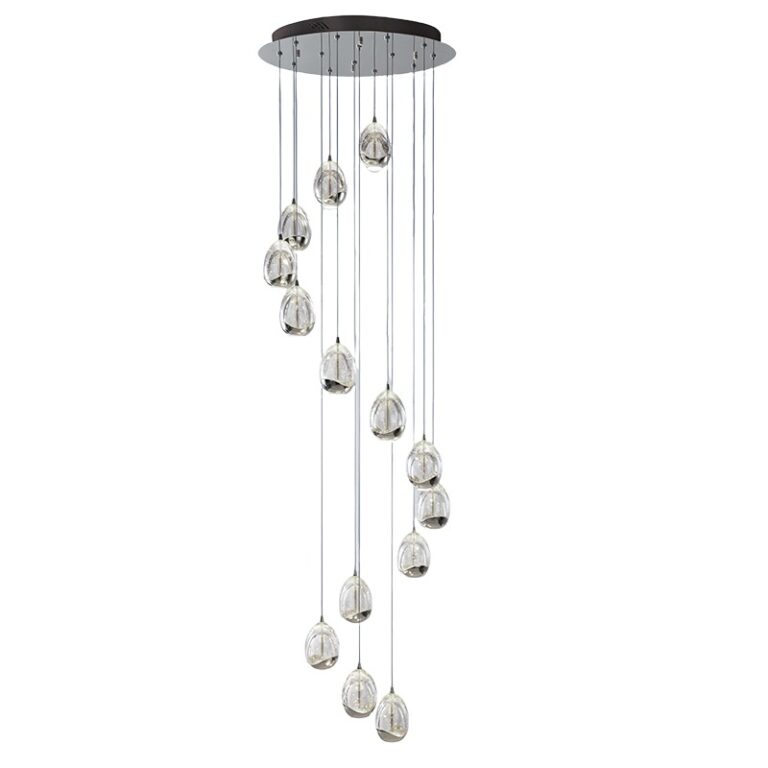
Let’s compare two paths—one classic, one modular. A crystal chandelier is a statement. But it is heavy, wide, and often fixed in its beam spread. Over a multi-flight stair, it can leave corners dim and mid-steps bright. A modular bubbled system distributes nodes along the drop. Each pendant becomes a light point near the user’s line of travel. With good drivers and clean wiring architecture, you get smoother dimming, higher comfort, and easier control integration. In short: less mass, more precision. And if a client later adds art on the wall, you can re-aim or re-space without rewiring the world—scalable, like a kit.
Case in point: a retrofit stairwell in a boutique hotel. Engineers replaced a single large fixture with a vertical array of 14 pendants. The team balanced lumen levels per flight, set a warm 2700–3000K gradient, and used a soft-start dimming protocol to avoid flicker during evening scenes. Guests reported fewer missed steps and better comfort at check-in (small data, but real). Energy draw dropped by double digits thanks to efficient drivers and better power distribution. The maintenance crew? Happier. No heavy rigging. No weekly dust battle—progress you feel on payroll.
Future outlook ties it together. Expect smarter controls that read occupancy and daylight, and adjust output per tier. Expect slimmer housings with integrated heat sinks to push LED life past 50,000 hours. For expressive stair cores, chandelier lights for staircase will act like a vertical canvas—modular drops, clean optics, and consistent CRI across batches. The shape language will evolve, but the principle holds: more points, better control, less glare. This is not about fashion; it is about safe steps, calm eyes, and easier service—funny how the quiet wins matter most.
Before you choose, evaluate three things. 1) Photometrics: check vertical illuminance at tread edges, not just floor lux. 2) Electrical quality: verify driver stability, dim-to-warm curve, and power factor under load. 3) Maintainability: access for cleaning, swap time per pendant, and spare-part consistency. If those three pass, the rest follows. You get a staircase that performs every day, not only on day one. For reference and deeper specifications, see kinglong.
